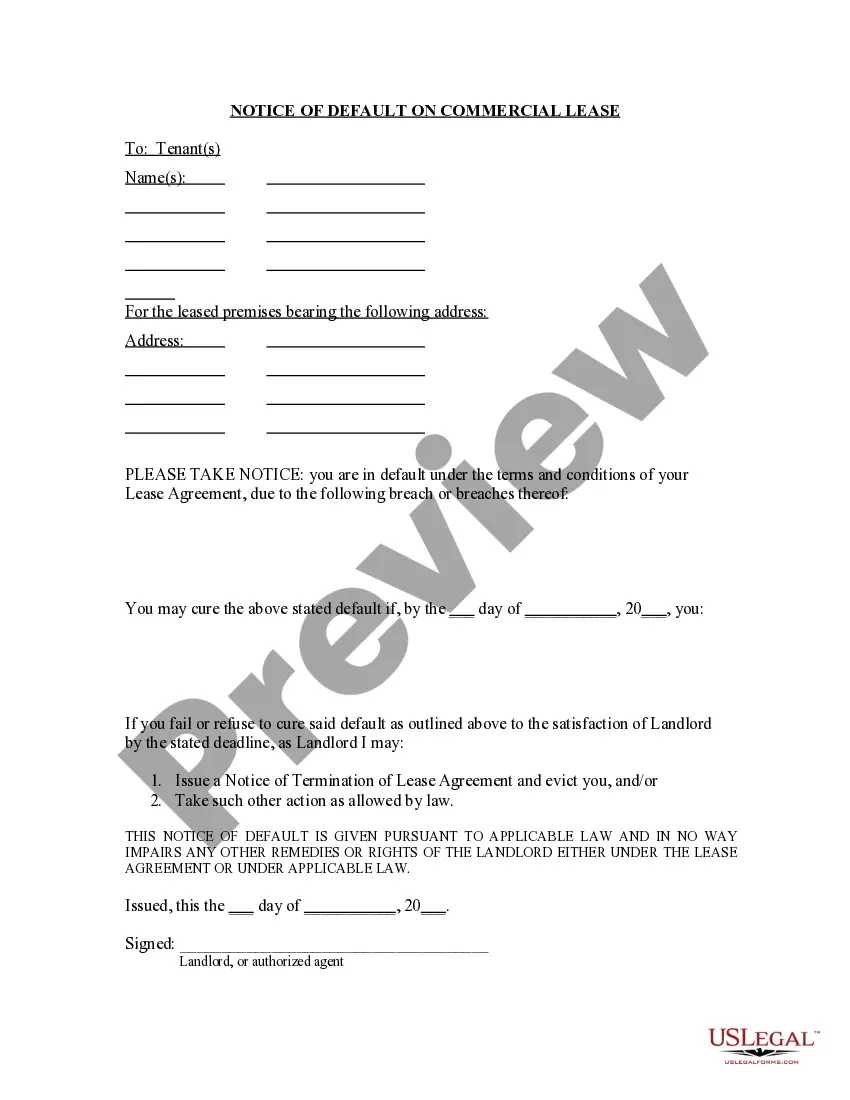
In landlord-tenant law, default refers to the failure of a tenant to timely pay rent due. In anticipation of such an occurence, landlords commonly require a new tenant to pay a security deposit, which may be used to remedy defaults in payment of rent and other monetary obligations under the rental agreement. In general, the landlord is required to give the tenant notice of the default before bringing eviction proceedings or applying security deposit proceeds to the payment in default. The fixing of a definite default date for payment of rent can be critical if it becomes necessary to evict a tenant for a default in the payment of rent. Landlords often require a background and/or reference check on prospective tenants in an attempt to minimize defaults in rent payments.
Notice Of Default Commercial Lease
Description Tenant Default Commercial Lease
How to fill out Massachusetts Letter From Landlord To Tenant As Notice Of Default On Commercial Lease?
Use US Legal Forms to get a printable Massachusetts Letter from Landlord to Tenant as Notice of Default on Commercial Lease. Our court-admissible forms are drafted and regularly updated by professional attorneys. Our’s is the most extensive Forms library online and provides cost-effective and accurate templates for customers and lawyers, and SMBs. The templates are grouped into state-based categories and some of them can be previewed before being downloaded.
To download samples, users need to have a subscription and to log in to their account. Hit Download next to any template you want and find it in My Forms.
For individuals who don’t have a subscription, follow the tips below to quickly find and download Massachusetts Letter from Landlord to Tenant as Notice of Default on Commercial Lease:
- Check to ensure that you get the correct form with regards to the state it’s needed in.
- Review the document by reading the description and by using the Preview feature.
- Hit Buy Now if it’s the template you want.
- Create your account and pay via PayPal or by card|credit card.
- Download the form to the device and feel free to reuse it multiple times.
- Use the Search field if you need to find another document template.
US Legal Forms offers a large number of legal and tax templates and packages for business and personal needs, including Massachusetts Letter from Landlord to Tenant as Notice of Default on Commercial Lease. Over three million users have used our service successfully. Choose your subscription plan and obtain high-quality forms within a few clicks.