Colorado Quitclaim Deed - Husband and Wife to a Trust

State:
Colorado
Control #:
CO-SDEED-8-24
Format:
Word; 
Rich Text
Instant download

Description

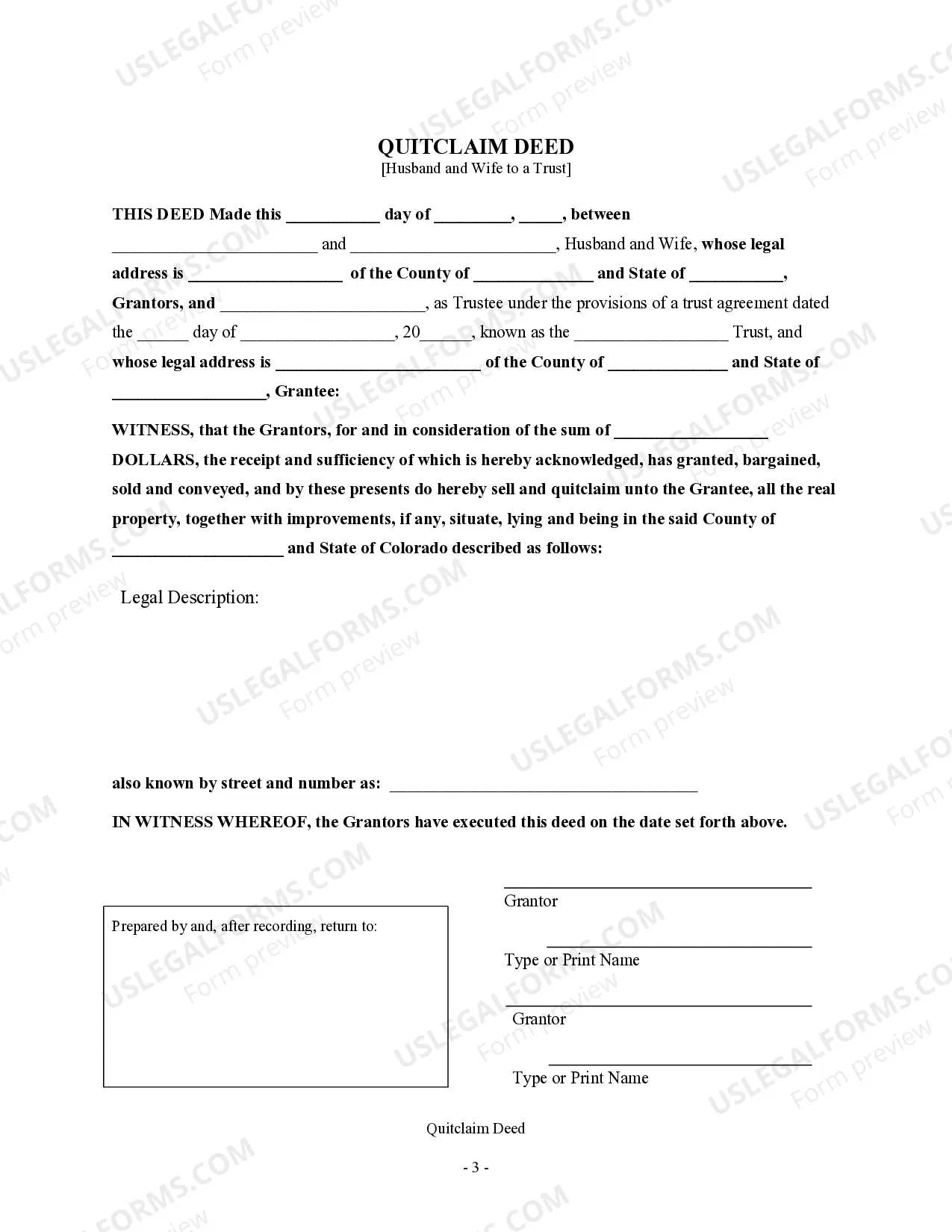
This form is a Quitclaim Deed where the Grantors are husband and wife and the Grantee is a Trust. Grantors convey and quitclaim the described property to grantee. This deed complies with all state statutory laws.

Free preview
  • Preview Quitclaim Deed - Husband and Wife to a Trust
  • Preview Quitclaim Deed - Husband and Wife to a Trust
  • Preview Quitclaim Deed - Husband and Wife to a Trust
  • Preview Quitclaim Deed - Husband and Wife to a Trust
  • Preview Quitclaim Deed - Husband and Wife to a Trust

Key Concepts & Definitions

A quitclaim deed is a legal instrument used to transfer interest in real property. The grantor (the party transferring the property) terminates any right and claim to the property, allowing the right or claim to transfer to the grantee (the recipient of the transfer), without any guarantee of clear title. In the context of 'quitclaim deed husband and wife to a trust', a married couple transfers their property rights directly to a trust. This process often involves interspousal transfer property clauses to manage how properties are handled within marriage and in estate planning scenarios.

Step-by-Step Guide to Transferring Property via Quitclaim Deed

  1. Prepare the Quitclaim Deed Form: Obtain the appropriate quitclaim deed form from online legal services or consult a family law attorney to ensure accurate completion.
  2. Enter Valid Information: Fill out the deed form by entering valid information, such as the names of parties involved, legal description of the property, and the details of the trust that will receive the property.
  3. Review and Verification: Both parties should review the form thoroughly. Verification might require phone number confirmation or other personal details for identity verification.
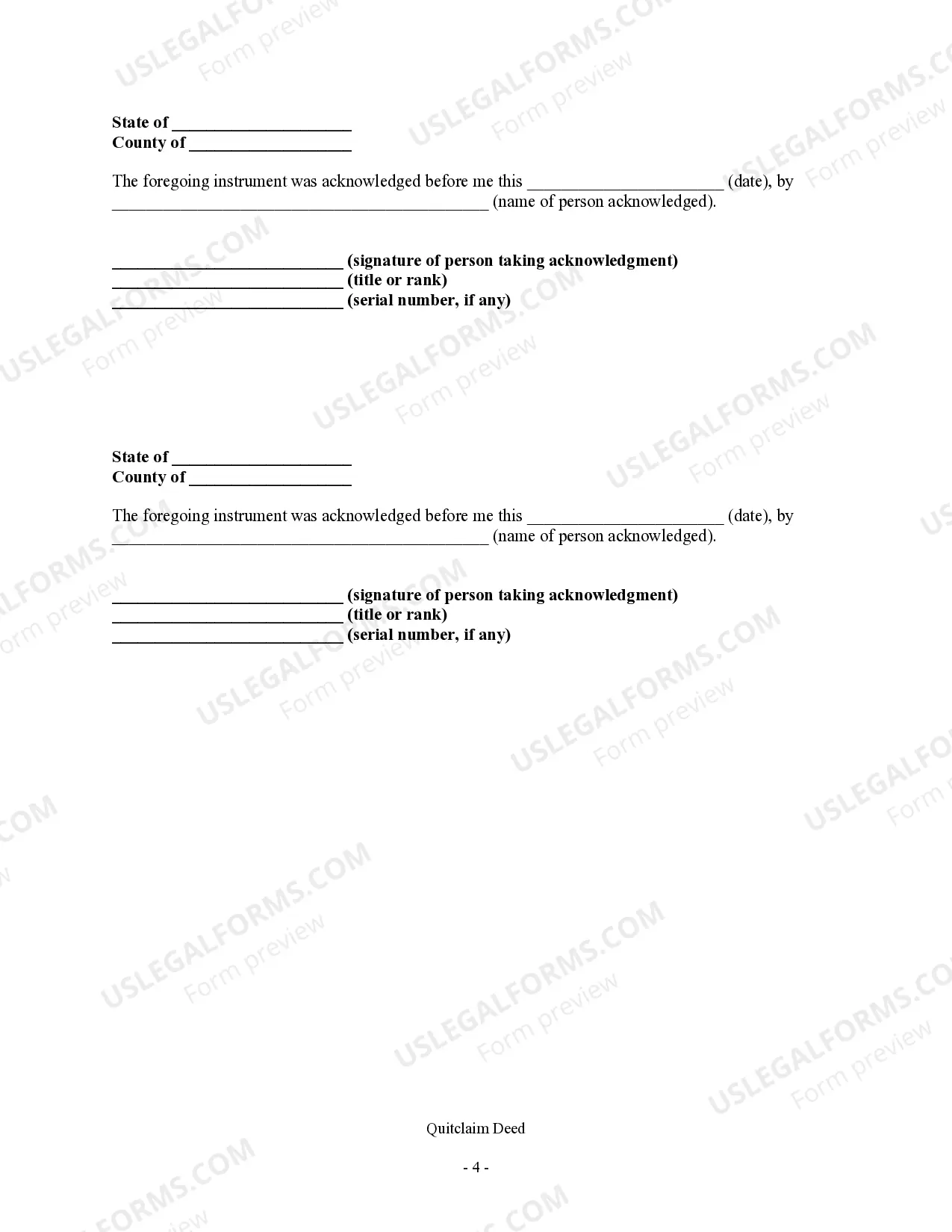
  4. Signature: Both husband and wife must sign the deed, potentially in the presence of a notary, depending on state law.
  5. File Legal Documents: File the signed deed at the local county recorder or land registry office to make the transfer legal and binding.
  6. Start Mortgage Process: If there's an existing mortgage on the property, contact the lender to discuss the implications of the transfer on the mortgage agreement.

Risk Analysis of Quitclaim Deeds

  • No Warranty: Quitclaim deeds do not guarantee a clear title; there might be other claims or liens against the property.
  • Financial Risk: If the grantee assumes property with undisclosed encumbrances or liens, they might incur unforeseen financial liabilities.
  • Legal Disputes: Poorly managed quitclaim deeds or improper filing can lead to legal disputes between parties, potentially involving extensive legal costs.

How to fill out Colorado Quitclaim Deed - Husband And Wife To A Trust?

The greater the number of documents you need to create - the more anxious you become.

You can discover a vast array of Colorado Quitclaim Deed - Husband and Wife to a Trust templates online, but you may not know which ones to trust.

Eliminate the confusion and simplify the process of finding samples with US Legal Forms. Obtain professionally drafted documents that are prepared to satisfy state requirements.

Provide the required information to create your account and settle your order using your PayPal or credit card. Choose a convenient file format and obtain your copy. Access every document you acquire in the My documents section. Simply navigate there to prepare a new version of the Colorado Quitclaim Deed - Husband and Wife to a Trust. Even when utilizing well-prepared templates, it remains essential to consider consulting your local attorney to verify that your filled-out form is completed correctly. Achieve more for less with US Legal Forms!

  1. If you currently hold a US Legal Forms subscription, Log In to your account, and you will see the Download button on the Colorado Quitclaim Deed - Husband and Wife to a Trust’s webpage.
  2. If you have never used our site before, complete the registration process by following these instructions.
  3. Verify that the Colorado Quitclaim Deed - Husband and Wife to a Trust is applicable in your state.
  4. Double-check your selection by reading the description or using the Preview feature, if available for the chosen document.
  5. Click on Buy Now to initiate the registration process and choose a pricing plan that fits your needs.

Form popularity

FAQ

Setting up a Colorado Quitclaim Deed - Husband and Wife to a Trust can have some disadvantages. First, transferring your house to a trust may limit your control over the property, as the trust's terms govern its use. Additionally, the process involves legal fees and possible tax implications that you should consider before proceeding. It's essential to weigh these factors carefully, and platforms like USLegalForms can help you navigate the complexities involved.

Choosing between a Colorado Quitclaim Deed - Husband and Wife to a Trust depends on your specific needs. A quitclaim deed can transfer property quickly and easily between parties, often without formal legal complications. However, a trust offers more protection and control over the assets, especially for future generations. For many, pairing a quitclaim deed with a trust can provide both immediate transfer convenience and long-term security.

To transfer property into a trust in Colorado, first, create a trust document that clearly outlines the terms and beneficiaries. Next, use a quitclaim deed to transfer the property by listing the trust as the new owner. Sign and notarize the deed before recording it with the county clerk. This method streamlines the process of managing assets within the Colorado Quitclaim Deed - Husband and Wife to a Trust.

Yes, a quitclaim deed can indeed transfer property from a trust. The process begins by designating the trustee as the grantor and the intended recipient as the grantee. This simple process allows the trustee to convey property rights without further obligations. Utilizing a Colorado Quitclaim Deed - Husband and Wife to a Trust ensures that the property transfer occurs smoothly.

Filling out a quitclaim deed to add a spouse involves listing the current property owner and the spouse as co-owners. Clearly define the property with a legal description, indicating the transfer is to a trust if applicable. Both individuals should sign the form in front of a notary. This process can effectively secure your property interests under the Colorado Quitclaim Deed - Husband and Wife to a Trust.

To fill out a Colorado quitclaim deed, start by obtaining a blank form tailored for your needs. Enter the names of the husband and wife as grantors, followed by the name of the trust as the grantee. Include a clear legal description of the property and any applicable dates. Finally, both parties must sign the document, and ensure to have it notarized for it to be valid.

Locate your current deed. Use the proper deed. Check with your title insurance company and lender. Prepare a new deed. Sign in the presence of a notary. Record the deed in the county clerk's office. Locate the deed that's in trust. Use the proper deed.

But you might be wondering if an owner can transfer a deed to another person without a real estate lawyer. The answer is yes. Parties to a transaction are always free to prepare their own deeds.A quitclaim deed, for example, is far simpler than a warranty deed.

It's usually a very straightforward transaction, but it's possible for a quitclaim deed to be challenged. If a quitclaim deed is challenged in court, the issue becomes whether the property was legally transferred and if the grantor had the legal right to transfer the property.

The drawback, quite simply, is that quitclaim deeds offer the grantee/recipient no protection or guarantees whatsoever about the property or their ownership of it. Maybe the grantor did not own the property at all, or maybe they only had partial ownership.

Trusted and secure by over 3 million people of the world’s leading companies

Colorado Quitclaim Deed - Husband and Wife to a Trust