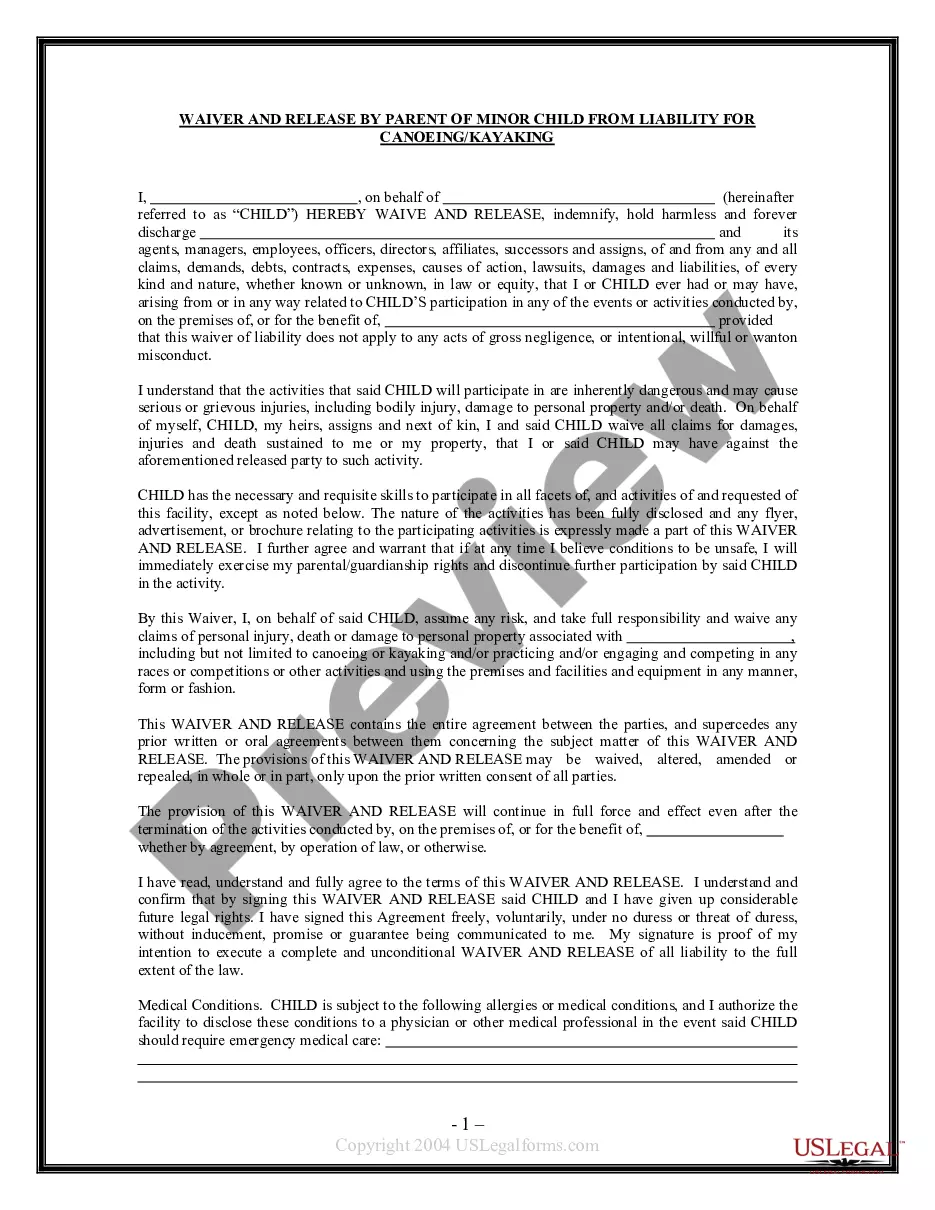
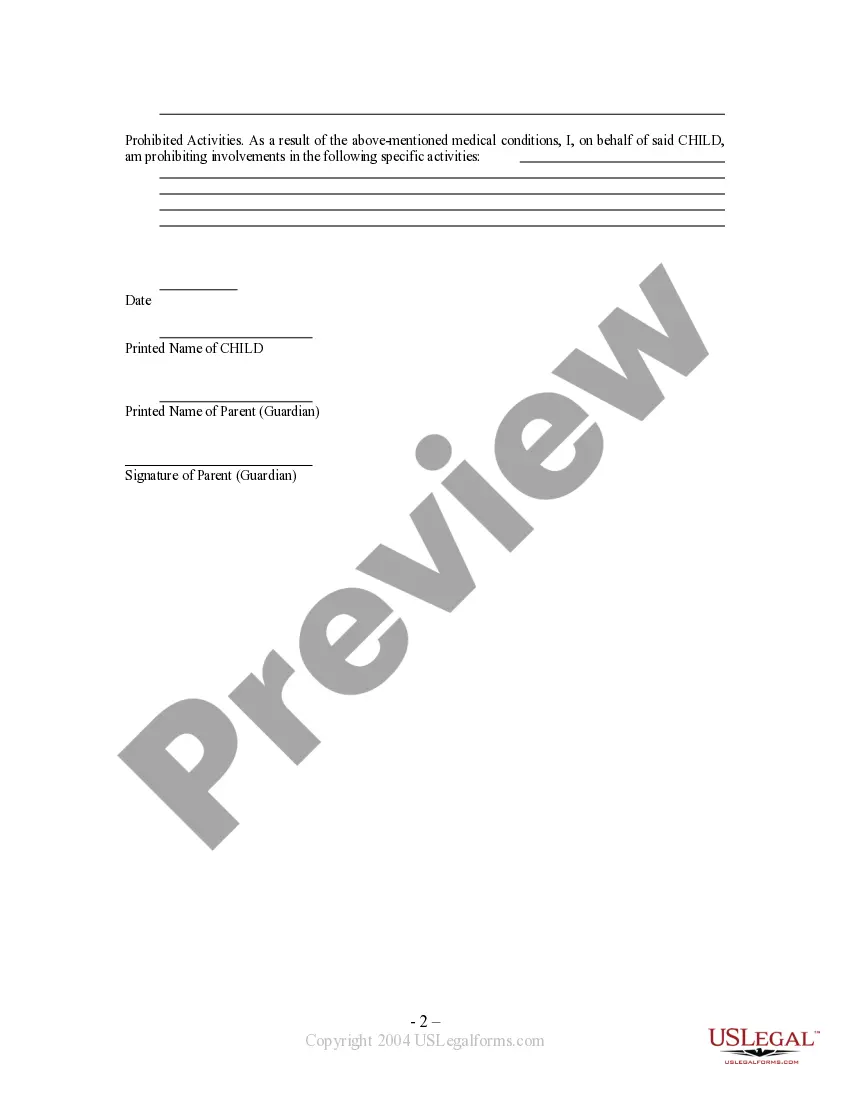
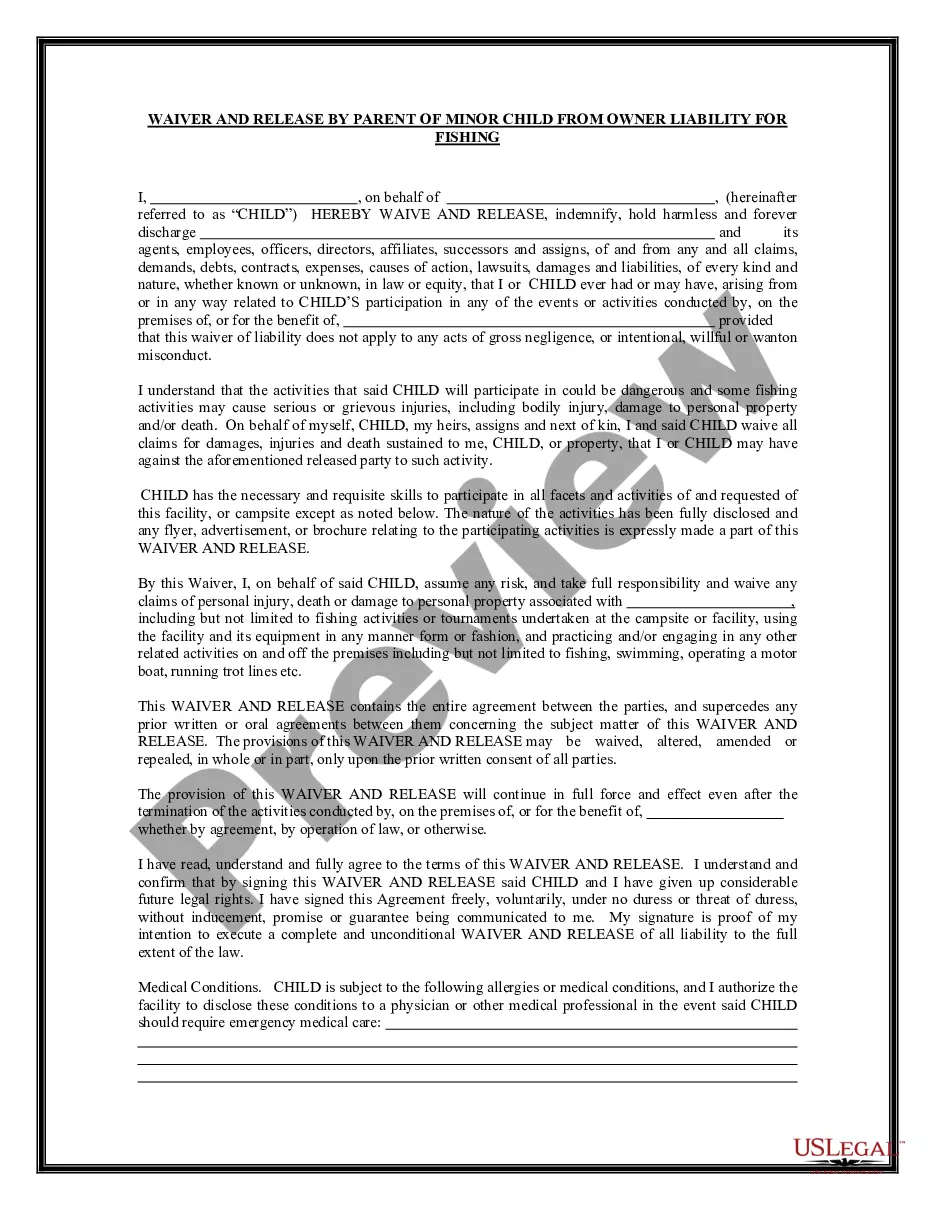
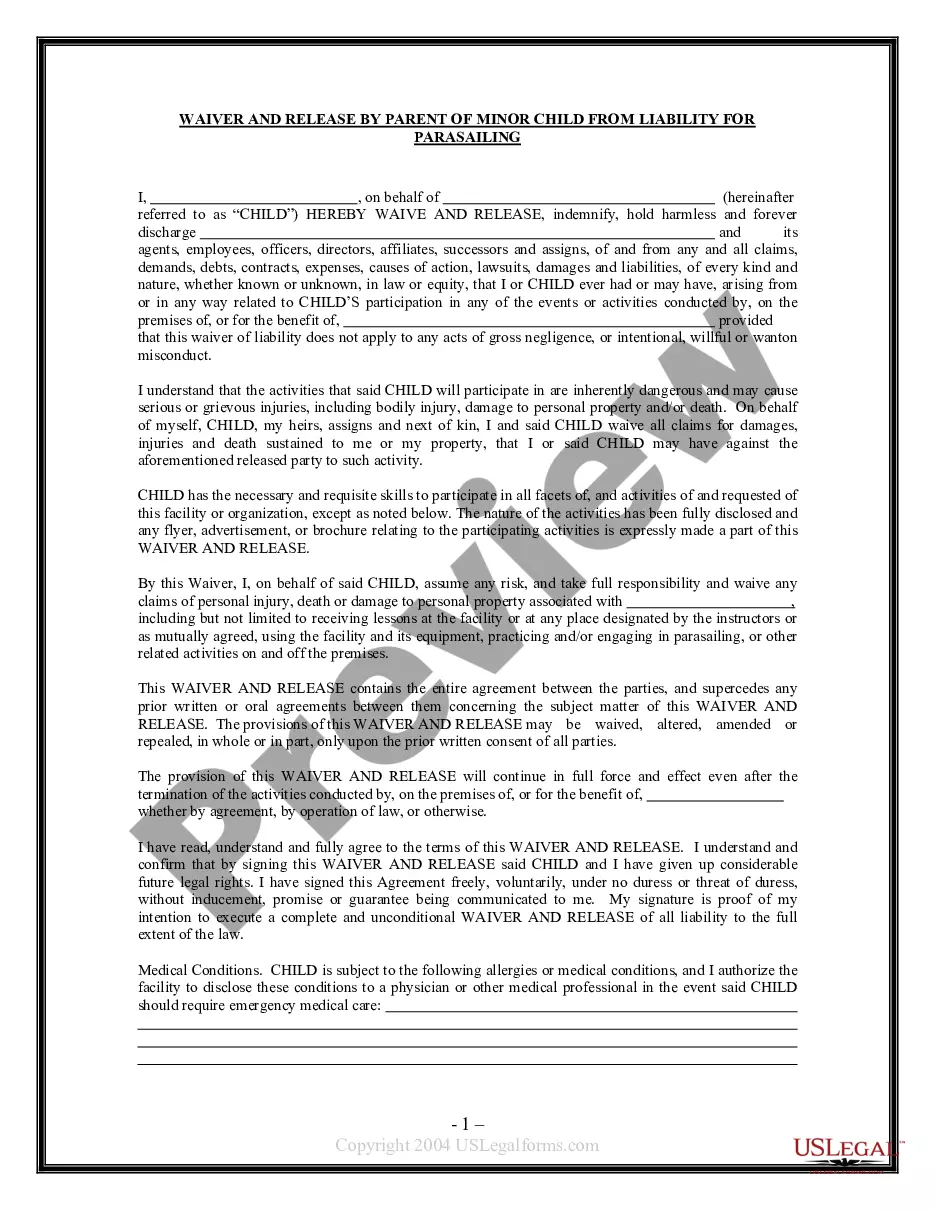
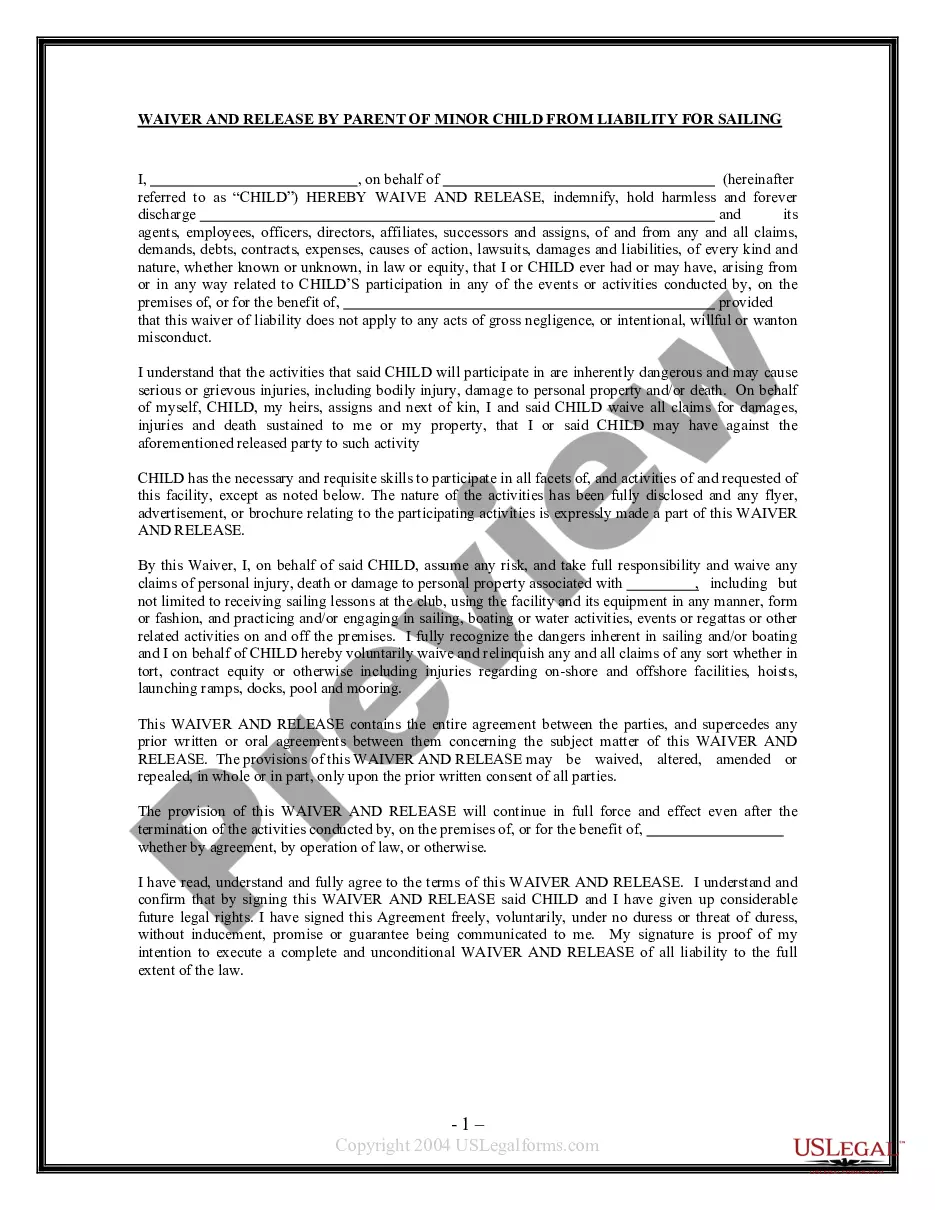
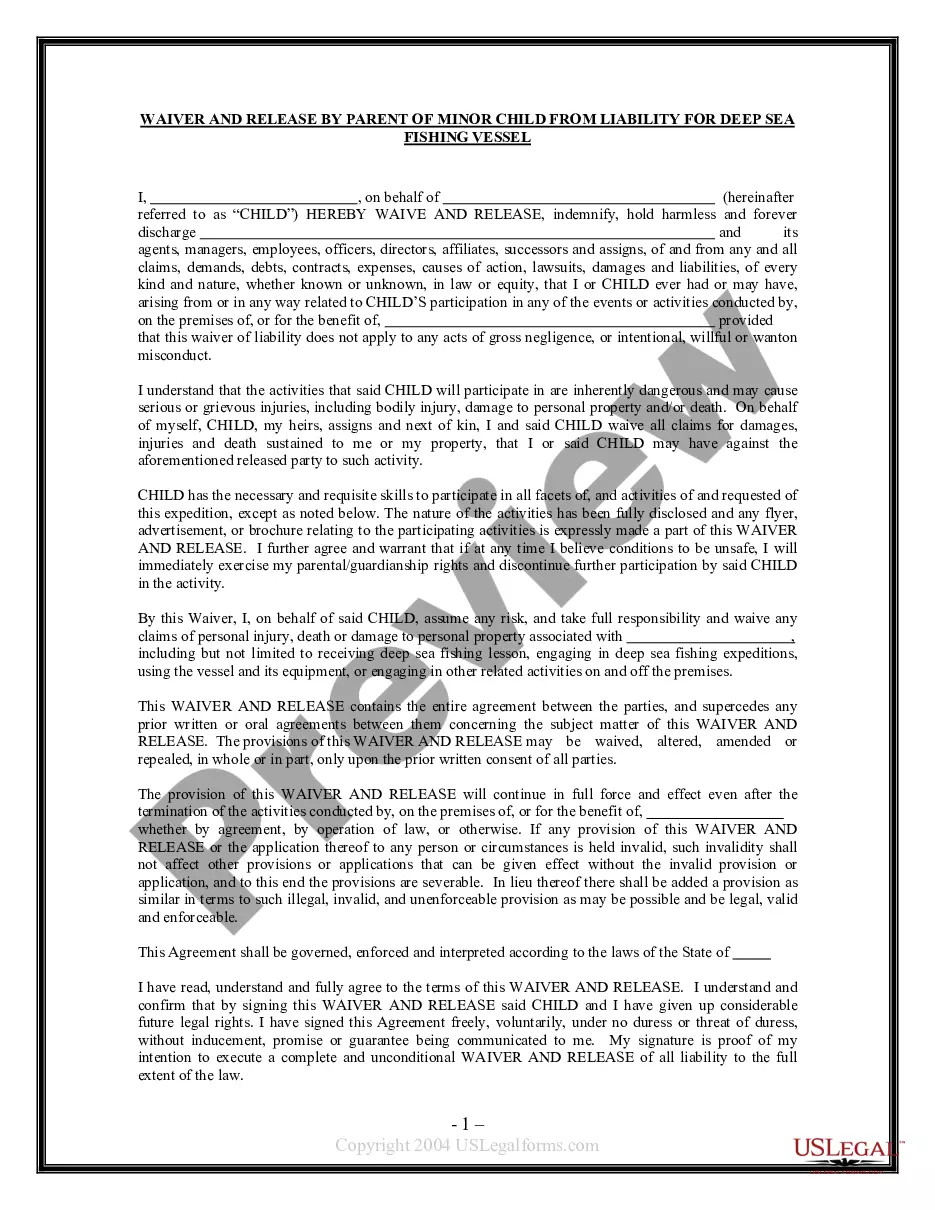
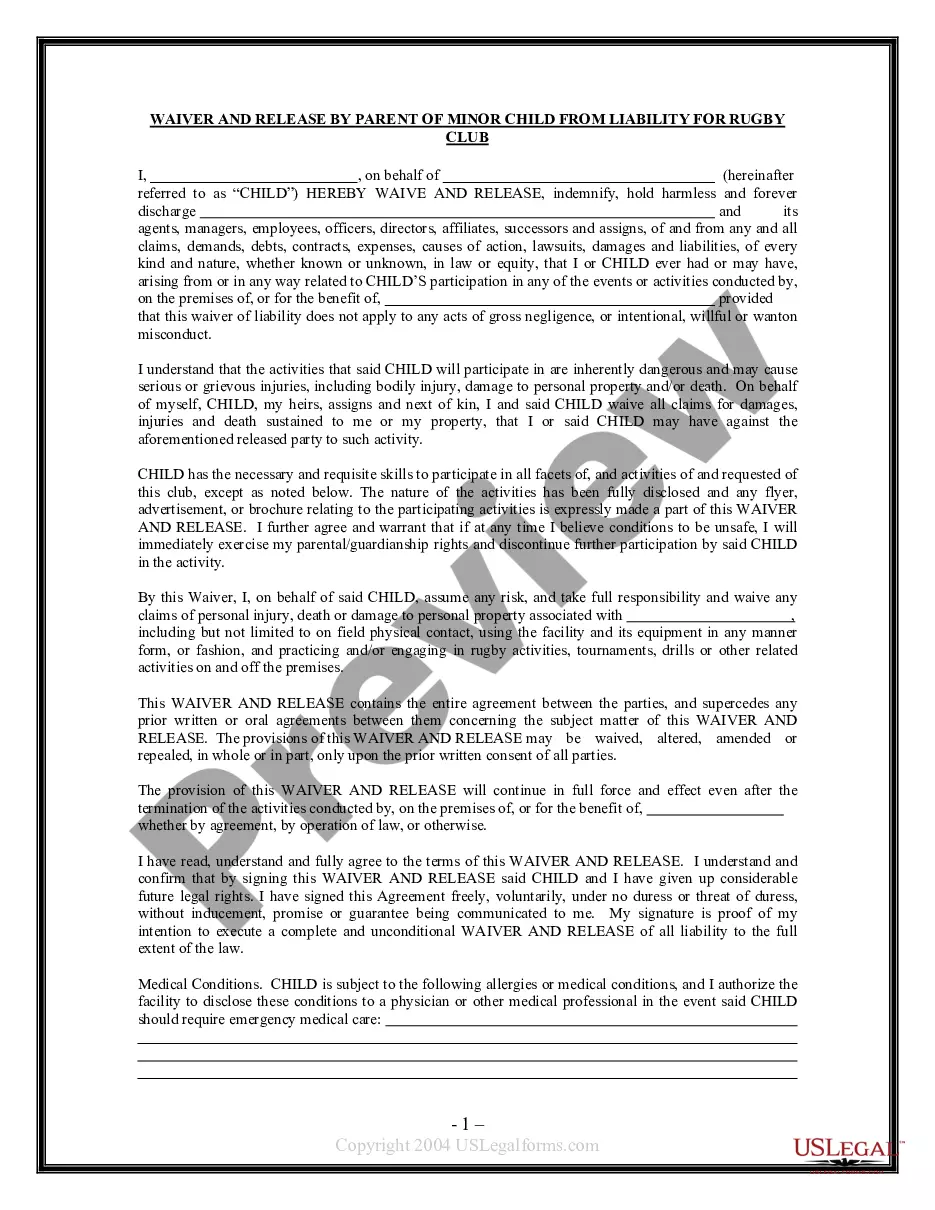
This form allows a parent or guardian to release a canoeing/kayaking facility from liability for injuries which may be incurred by a minor child while on the premises, taking part in activities, etc.
Alabama Waiver and Release From Liability For Minor Child for Canoeing - Kayaking
Category:
State:
Multi-State
Control #:
US-WAV-43M
Format:
Word;
Rich Text
Instant download
Description
Free preview

How to fill out Waiver And Release From Liability For Minor Child For Canoeing - Kayaking?
It is feasible to spend numerous hours online searching for the legal document template that meets the federal and state requirements you will need.
US Legal Forms provides a vast array of legal forms that have been reviewed by professionals.
You can easily download or print the Alabama Waiver and Release From Liability For Minor Child for Canoeing - Kayaking from the service.
Check the form description to confirm that you have selected the appropriate form. If available, use the Preview button to view the document template as well. If you wish to find another version of the form, use the Search field to locate the template that suits your needs and requirements. Once you have found the template you require, click Purchase now to proceed. Select the pricing plan you need, enter your details, and register for an account on US Legal Forms. Complete the transaction. You can use your credit card or PayPal account to pay for the legal form. Choose the format of your document and download it to your device. Make modifications to your document if necessary. You can fill out, modify, sign, and print the Alabama Waiver and Release From Liability For Minor Child for Canoeing - Kayaking. Download and print a vast number of document templates using the US Legal Forms website, which offers the largest selection of legal forms. Utilize professional and state-specific templates to manage your business or personal needs.
- If you possess a US Legal Forms account, you can Log In and click the Obtain button.
- Then, you can fill out, modify, print, or sign the Alabama Waiver and Release From Liability For Minor Child for Canoeing - Kayaking.
- Each legal document template you purchase is yours permanently.
- To obtain another copy of a purchased form, visit the My documents tab and click the corresponding button.
- If you are using the US Legal Forms website for the first time, follow the simple instructions below.
- First, ensure that you have selected the correct document template for the county/city of your choice.
Form popularity
FAQ
A parental release of liability form is a legal document that protects organizations from claims or lawsuits arising from injuries that a minor child may suffer during activities like canoeing or kayaking. Specifically, the Alabama Waiver and Release From Liability For Minor Child for Canoeing - Kayaking provides parents with a means to acknowledge the inherent risks involved in these activities and relinquish their right to sue in case of an accident. By signing this form, parents not only safeguard the organization but also ensure their child can participate in these exciting outdoor experiences without unnecessary legal hurdles. For a seamless process, you can find a reliable template for this form on the US Legal Forms platform, making it easy to ensure compliance and protection.
A release of liability, also known as a liability waiver or a hold harmless agreement, is a contract in which one party agrees not to hold another party liable for damages or injury. These contracts are common in fields that involve some risk to property, finances, or health.
Although legal in their own right, waivers can't be used to completely shield event organisers from liability as a result of their negligence. Under the Unfair Contract Terms Act, activity providers can't exclude or restrict liability for injury or death caused as a result of their negligence.
A liability waiver, or release waiver, is a legal document that a company or organization requires members of the public to sign in order to protect their organization from being sued if you sustain an injury.
Liability waivers are enforceable in California solely to the extent they shift to the customer the risk of ordinary negligence.
A liability waiver is a legal document that a person who participates in an activity may sign to acknowledge the risks involved in their participation. By doing so, the company attempts to remove legal liability from the business or person responsible for the activity.
Although a waiver is legal, it is misleading. An organiser or business owner cannot exclude or restrict liability for personal injury or death caused by negligence. This is set out in the Unfair Contract Terms Act 1977. Businesses such as gyms and event organisers must comply with the various sections of this Act.
AN AGREEMENT NOT TO SUE THE RELEASEES for any loss, injury, costs or damages of any form or type, howsoever caused or arising, and whether directly or indirectly from the participation of my minor child/ward in any aspect of the EVENT; and. 4.
A liability waiver may be deemed invalid if it is not clear, explicit, and comprehensible. A waiver that is written in a small font such that it is not clearly legible, or one that is written in language that is especially difficult or confusing, may be invalid under the law.
The Waiver must be clearly worded and unambiguous in its intent to relieve any and all legal liability, even liability for negligence. The Waiver should be prominent and not hidden in the fine print of a long contract. The Waiver must be signed by the person who it is being used against.